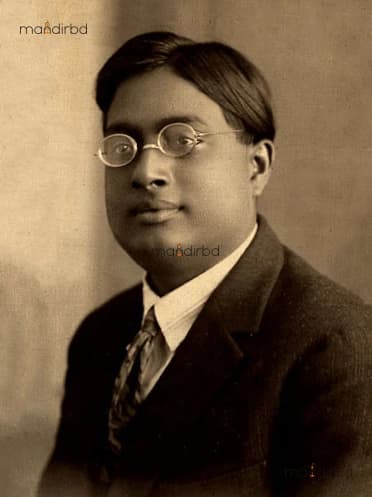
Radhanath Sikdar
(রাধানাথ শিকদার)
Biography
Radhanath Sikdar (1813–1870) was an eminent Bengali mathematician, surveyor, and scientist from India. Born on October 12, 1813, in Jorasanko, Kolkata, West Bengal, he is best remembered for his pioneering mathematical calculations that determined the height of Peak XV, which was later named Mount Everest, the highest peak in the world. Sikdar joined the Great Trigonometrical Survey of India in 1831 as a computer (a designation for mathematical calculators at the time) under the leadership of George Everest. His exceptional mathematical abilities quickly made him an indispensable asset to the survey. He formulated new mathematical methods for geodetic surveying and made significant advancements in the field. In 1852, using the data collected during the survey, Sikdar calculated that Peak XV was exactly 29,002 feet high, establishing it as the tallest mountain in the world. Although the peak was later named after George Everest, Sikdar's crucial contribution remains a landmark achievement in the history of science and surveying. Beyond surveying, Sikdar made notable contributions to meteorology. He served as the superintendent of the Government Observatory in Kolkata, where he introduced systematic meteorological observations and data collection. He passed away on May 17, 1870, leaving behind a legacy of scientific excellence and academic dedication.
References & Learn More
Biography of Radhanath Sikdar
Notable Contributions
No linked contributions found in the database.