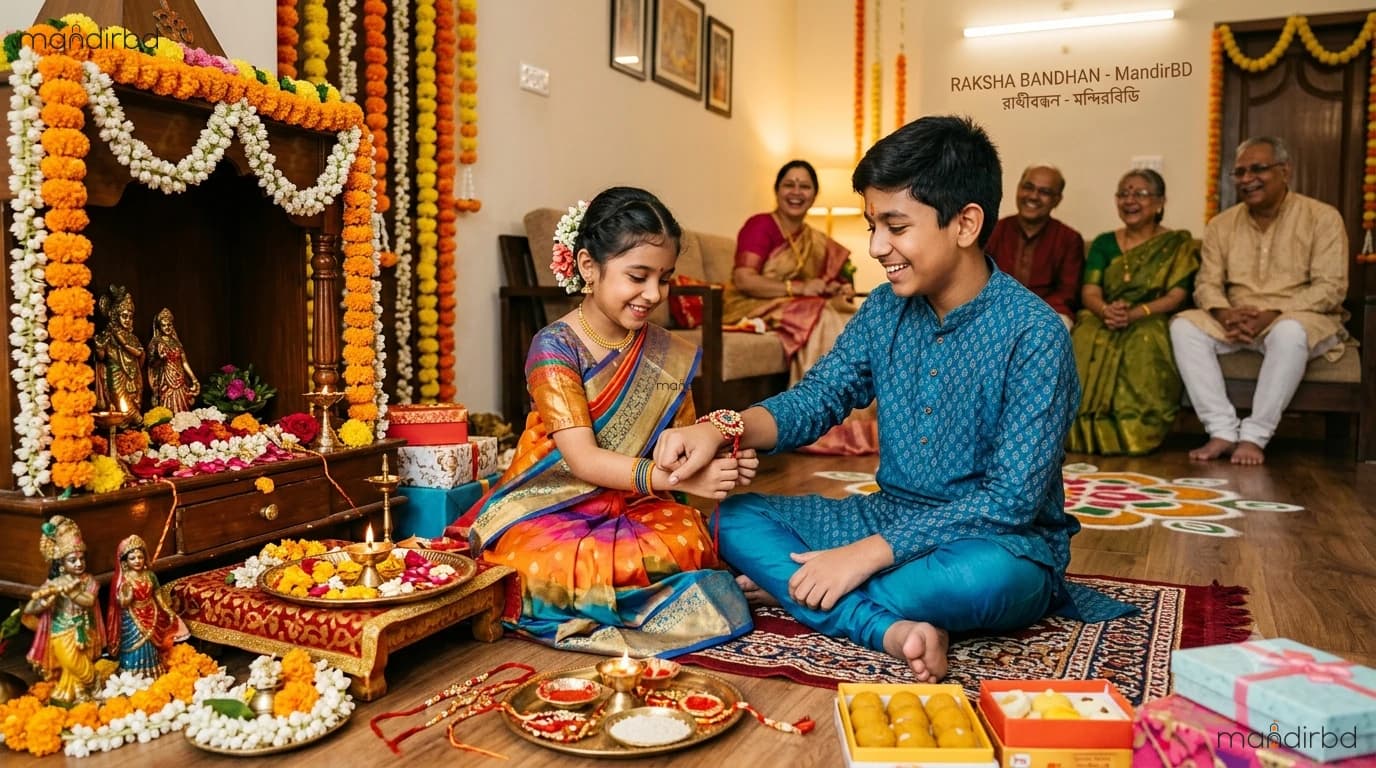
Raksha Bandhan, popularly known as Rakhi Purnima, is an ancient and deeply revered Vedic and cultural festival celebrated across South Asia and global Sanatan communities on the full moon day of the Hindu lunar month of Shravana (Shravana Purnima). Derived from the Sanskrit roots "Raksha" (protection) and "Bandhan" (a bond or tie), the festival fundamentally embodies the timeless ideals of mutual safeguarding, unconditional affection, righteousness, and profound familial devotion. While traditionally celebrated as a sacred bond between brothers and sisters—wherein a sister ties an amulet or sacred thread called 'Rakhi' on her brother's right wrist, praying for his long life, spiritual fortitude, and prosperity, and the brother reciprocates with gifts and an enduring pledge to protect her dignity and welfare—the festival historically encompasses a much broader spiritual and societal scope. It symbolizes the universal fraternity of humankind, crossing bloodlines to establish voluntary kinship, guru-disciple covenants, and collective social harmony. In modern history, Nobel laureate Rabindranath Tagore revitalized Raksha Bandhan during the 1905 Partition of Bengal as a powerful socio-cultural instrument of indivisible brotherhood and communal harmony.
রাখীবন্ধন
Last observed
Fri, August 28
About
Religious Significance
The Mahabharata Legend: Lord Krishna and Draupadi:
During the Rajasuya Yajna, when Lord Krishna hurled the Sudarshana Chakra to vanquish the tyrannical Shishupala, His index finger was cut and started bleeding profusely. While the court rushed for remedies, Draupadi, without a moment's hesitation, tore a strip of silk from her royal saree and tightly bandaged Krishna's bleeding finger. Touched by her unconditioned devotion and sisterly love, Krishna accepted her as His sister and declared Himself indebted to each thread of that fabric. Years later, when the Kauravas attempted to disrobe Draupadi during the infamous game of dice in the royal assembly, Krishna repaid the debt by miraculously providing unending streams of cloth, preserving her chastity and honor.
King Bali and Goddess Lakshmi (Srimad Bhagavatam & Bhavishya Purana):
After Lord Vishnu appeared as the dwarf Brahmin Vamana and reclaimed the three worlds from King Bali, the demon king surrendered entirely to the Lord. Pleased with his supreme surrender, Vishnu agreed to serve as Bali’s personal gatekeeper in Patala (the Netherworld). Distressed by her Lord’s absence from Vaikuntha, Goddess Lakshmi disguised herself as a humble woman and sought shelter in Bali’s court. On the day of Shravana Purnima, she tied a sacred thread around Bali’s wrist and accepted him as her brother. When Bali generously offered her a gift of her choice, she revealed her true identity and requested Vishnu’s return to Vaikuntha. Bali happily honored the sacred bond of the Rakhi, giving rise to the festival.
Indra and Indrani (Bhavishya Purana - Uttar Parva):
According to the Bhavishya Purana, during an ancient war between demigods and demons that lasted twelve celestial years, the king of heaven, Indra, suffered repeated defeats and lost his throne. On the advice of Guru Brihaspati, Indra’s consort Sachi (Indrani) consecrated a sacred protective talisman (Raksha Sutra) with Vedic mantras and tied it on Indra’s right wrist on Shravana Purnima. Empowered by the spiritual potency of this protective charm, Indra led the gods to decisive victory, establishing the ancient tradition of tying amulets before undertaking righteous battles.
Yama and Yamuna (The Bond of Immortality):
Lord Yama (the God of Death) had not visited his sister Yamuna for years. When he finally visited her residence on Shravana Purnima, Yamuna treated him with lavish hospitality, marked his forehead with a sacred vermilion Tilak, and tied a Rakhi on his hand. Overwhelmed with affection, Yama granted her a boon that any brother who receives a Rakhi and Tilak from his sister on this day would be liberated from the fear of untimely death and fear of Naraka.
Historical Legendas (Queen Karnavati, Roxana, and King Porus):
Historical traditions cite that during Alexander the Great's invasion of India in 326 BCE, his wife Roxana sent a sacred thread to King Porus (Puru), seeking an assurance for Alexander’s life. When Porus had the chance to deliver a mortal blow to Alexander on the battlefield, he looked at the thread on his wrist and spared him. In another well-known chronicle of 1535 CE, Rani Karnavati of Mewar sent a Rakhi to Mughal Emperor Humayun seeking military assistance against the siege laid by Bahadur Shah of Gujarat, underscoring the sacred obligation associated with the thread beyond geopolitical boundaries.
Rabindranath Tagore and the 1905 Partition of Bengal:
On 16 October 1905, to protest against the British partition of Bengal designed on communal lines, Nobel laureate Rabindranath Tagore transformed Raksha Bandhan into a socio-cultural phenomenon. People from all communities marched to the Ganges, bathed, and tied Rakhis on each other's wrists as a vow of indivisible unity, brotherhood, and national resistance.
Rituals & Observances
Avoiding the Inauspicious 'Bhadra Kaal':
According to classical astrological texts like Muhurta Chintamani ("Bhadrayam dve na kartavye Shravani Phalguni tatha"), Raksha Bandhan must strictly not be performed during 'Bhadra Mukha' (the inauspicious astrological shadow of Saturn's sister). The ritual must be conducted during the auspicious Aparahna (afternoon) or Pradosha Kaal once the Bhadra phase concludes.
Preparation of the Sacred Puja Thali:
A brass, copper, or silver plate (Thali) is traditionally arranged with sacred ceremonial items:
- A pure Ghee Diya (lamp for performing Aarti)
- Chandan (sandalwood paste) and Roli/Kumkum (vermilion)
- Akshat (unbroken raw rice grains, signifying immortality and abundance)
- Durva grass blades and Tulsi leaves (for purification and health)
- Sacred Rakhis / Raksha Sutras
- Traditional Indian sweets (Laddus, Sandesh, or Kheer)
- A sanctified coconut (Shreefal) and Gangajal
Applying the Tilak and Performing Aarti:
The brother sits facing East or North on a clean mat, often covering his head with a handkerchief or scarf. The sister applies a sacred Tilak of Kumkum and sandalwood on his forehead with her ring finger, placing a few grains of Akshat over it. She then performs a ceremonial Aarti by waving the illuminated Ghee Diya clockwise around his face to ward off evil energies and invoke divine protection.
Tying the Rakhi with the Vedic Raksha Mantra:
The sister firmly ties the Rakhi around the brother's right wrist while chanting the revered Vedic mantra:
"Yena baddho Bali raja danavendro mahabalah |
Tena tvam abhibadhnami rakshe ma chala ma chala ||"
(Translation: "I tie upon you that same sacred protective shield by which the mighty demon king Bali was bound. O Raksha Sutra, stay steadfast and protect this soul from all harm forever.")
Sweet Feeding, Exchange of Gifts & Blessings:
The sister feeds sweets to her brother, and the brother reciprocates by offering gifts, money, and a solemn pledge of lifelong protection. Younger siblings touch the feet of elder brothers and sisters to receive their blessings, followed by the entire family participating in a festive Sattvic vegetarian feast.
Universal Observance & Environmental Vows (Vriksha Raksha):
In modern observance, the ritual transcends households: sisters tie Rakhis on border-security soldiers, emergency servicemen, and social workers. Additionally, communities observe 'Vriksha Raksha' by tying Rakhis to sacred Peepal, Banyan, and Neem trees, taking solemn vows to protect Mother Nature.
Day-by-Day Schedule
Raksha Bandhan 2026
Aug 28, 2026PurnimaKey Timings
6:30 AM to 10:18 AM
When is রাখীবন্ধন?
Where this festival is held
We don't know yet which temples observe রাখীবন্ধন.
Know a temple that observes রাখীবন্ধন?
No answers yet
Ask about this →Frequently Asked Questions
When is রাখীবন্ধন?
রাখীবন্ধন was last observed on Friday, August 28, 2026 (Purnima).
What is the date of Raksha Bandhan in 2026?
In 2026, Raksha Bandhan falls on Monday, 3 August 2026, based on the Shravana Purnima tithi in the Hindu lunar calendar. Local calendars may show a slight variation depending on sunrise and sunset timings.
What is the auspicious muhurat (timing) for Raksha Bandhan in 2026?
The most auspicious time to perform Raksha Bandhan in 2026 is during the Pradosh Kaal or Aparahna period on 28 August, after the inauspicious Bhadra phase has passed. A favorable window is approximately 6:30AM to 10:18 AM Bangladesh Time.
What is Bhadra Kaal and why is it avoided during Raksha Bandhan?
Bhadra Kaal is an inauspicious astrological period ruled by Saturn’s sister, during which performing auspicious acts like Raksha Bandhan is strictly prohibited. According to classical texts, tying a Rakhi during Bhadra may invite misfortune, so the ritual must be postponed until Bhadra ends.
What is the main Vedic mantra recited while tying the Rakhi?
The primary Vedic mantra chanted while tying the Rakhi is: 'Yena baddho Bali raja danavendro mahabalah | Tena tvam abhibadhnami rakshe ma chala ma chala ||'. This mantra invokes divine protection and eternal bond for the brother.
Why is Shravana Purnima significant for Raksha Bandhan?
Shravana Purnima is the full-moon day of the Hindu lunar month of Shravana, deeply revered in scriptures. It marks the divine bond between Goddess Lakshmi and King Bali, and Lord Krishna’s protection of Draupadi, elevating the festival’s spiritual significance.
What are the rules for applying the tilak during Raksha Bandhan?
The brother is seated facing north or east. The sister applies a tilak of sandalwood paste and kumkum on his forehead using her ring finger, places a few grains of unbroken rice (akshat) on it, and performs an aarti to invoke divine blessings.
What is the significance of the color and material of the Rakhi?
The color and material of the Rakhi vary by tradition and personal choice. Common colors include red, yellow, and green, symbolizing love, prosperity, and harmony. The Rakhi itself represents the unbreakable bond of protection and affection between siblings.
What gifts are traditionally exchanged between siblings on Raksha Bandhan?
Brothers traditionally give gifts such as money, jewelry, clothing, or useful items to their sisters, while sisters may present sweets, clothes, or personal tokens. Gifts symbolize mutual respect, love, and lifelong commitment.
Is Raksha Bandhan limited only to biological siblings?
No, Raksha Bandhan is not limited to biological siblings. It extends to gurus and disciples, friends, neighbors, and even strangers, symbolizing universal brotherhood, mutual respect, and protection. Rabindranath Tagore popularized this broader interpretation during the 1905 Bengal Partition.
How is environmental conservation linked with Raksha Bandhan?
In contemporary practice, 'Vriksha Raksha' (tree Rakhi) is observed where people tie Rakhis on sacred trees like Peepal, Banyan, or Neem, taking a vow to protect nature. This reflects the festival’s evolving role in fostering ecological responsibility.
When is rakhi bandhan rakhi purnima 2026
In 2026, the sacred festival of Raksha Bandhan (Rakhi Purnima) will be celebrated on Friday, August 28, 2026. According to classical Vedic astrology, the Rakhi ceremony must avoid the inauspicious Bhadra period and should ideally be performed during the auspicious Aparahna (afternoon) or Pradosha (evening) Muhurat.