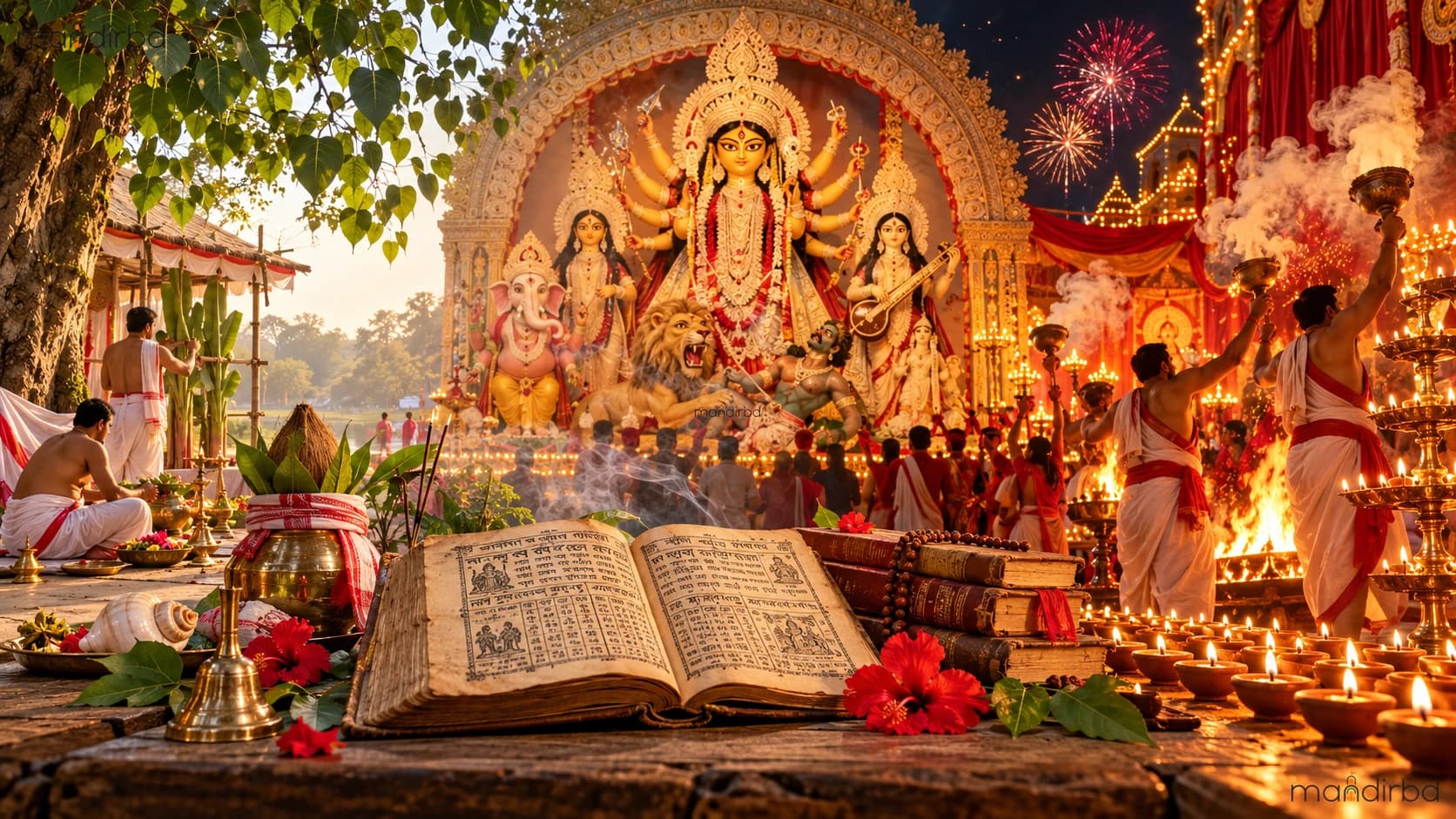
Autumn brings with it the majestic rhythm of the Dhak, the divine fragrance of Shiuli flowers, and the joyous arrival of Maa Durga. For the global Sanatani community, Sharadiya Durgotsav is the zenith of spiritual and cultural celebration. However, in today’s era of social media aesthetics and commercial trends, we often unknowingly deviate from our scriptural roots.
A prominent example of this is the modern trend of attaching the prefix 'Maha' (Great/Supreme) to every single day of the festival. Today, it is incredibly common to see WhatsApp statuses and Facebook posts wishing people a "Subho Maha-Chaturthi," "Maha-Panchami," "Maha-Shasthi," or "Maha-Saptami."
But as conscious Sanatanis, we must ask: Is this terminology actually supported by our Shastras? What do our ancient Puranas and Smriti texts say? Today, on MandirBD, let us dive deep into scriptural evidence and spiritual philosophy to uncover the truth.
The Spiritual Essence of the Word 'Maha'
In Sanatani philosophy, the word 'Maha' carries immense spiritual weight. It denotes the supreme, the ultimate, and that which transcends the ordinary material realm. Durga Puja is not a static event; it is a progressive spiritual journey. The spiritual energy does not reach its absolute zenith on the very first day. Rather, it builds up step-by-step, reaching its highest manifestation only at a specific juncture. Therefore, calling every day 'Maha' dilutes the profound significance of the word.
The Progression of Rituals: Preparation vs. Culmination
If we look at the structural architecture of the Puja from Shasthi to Navami, the distinction becomes crystal clear:
Shasthi (Bodhan and Adhibas): This is the day of preparation. The Goddess is awakened (Bodhan) under the sacred Bilva (woodapple) tree, invited, and welcomed. It is the spiritual initiation of the festival.
Saptami (Pran Pratishtha): With the placement of the Navapatrika (the nine sacred plants) and the ritual of infusing life (Pran Pratishtha) into the clay idol, the core worship begins.
Ashtami and Navami (The Zenith): These two days represent the absolute climax of the Puja. It is during these days that the supreme cosmic energy of the Mother Goddess is fully awakened and the deepest connection between the devotee and the divine is established.
Because Shasthi and Saptami are foundational and preparatory phases, the ancient sages never attached the 'Maha' prefix to them.
The Verdict of Smarta Raghunandana's 'Durgotsavatattva'
The revered 16th-century Smriti scholar of Bengal, Smarta Raghunandana Bhattacharya, provided explicit directives regarding this in his authoritative text, the Ashtabingshatitattva (specifically in the Durgotsavatattva section). He strictly prohibited the use of 'Maha' before all tithis (lunar days) of the festival, reserving it exclusively for Ashtami and Navami. He also provided the profound reasoning behind this:
Maha-Ashtami (Deliverance from Supreme Danger): The scriptures state: "Mahabipattarakatvad geeyatehasau Mahashtami." (Because the Supreme Goddess manifested to deliver the three worlds from a 'Maha-bipat' or a great cosmic catastrophe, this specific tithi is celebrated as Maha-Ashtami.)
Maha-Navami (Bestower of Supreme Wealth): The scriptures further state: "Mahasampaddayakatvat sa Mahanavami mata." (Because this tithi blesses the devotee with 'Maha-sampad'—supreme spiritual and material wealth, perfection, and devotion—it is recognized universally as Maha-Navami.)
The Irrefutable Evidence of the Kalika Purana
The Kalika Purana, one of the most authoritative texts of Shakta philosophy, clearly outlines the names and rituals of each day of Durga Puja. There is absolutely no mention of 'Maha' for Shasthi or Saptami:
Regarding Shasthi and Saptami: The text states, "Bodhayedbilwashakhasu shasthyang devi phaleshu cha" (Awaken the Goddess on the branch of the Bilva tree on Shasthi) and "Saptamyang bilwashakhang tamahritya pratipujayet" (Worship the Goddess on Saptami). Notice that they are simply referred to as Shasthi and Saptami.
Regarding Ashtami and Navami: "Ashwinasya tu shuklasya bhaved ya ashtami tithi. Mahashtamiti sa prokta devyah pritikari para. Tatenanu navami ya syat sa Mahanavami smrita." (The Ashtami tithi of the bright half of Ashvin is immensely dear to the Goddess and is declared as 'Maha-Ashtami'. The tithi that follows it is remembered as 'Maha-Navami'.)
The Cosmic Significance of Sandhi Puja
Another crucial reason why only Ashtami and Navami are termed 'Maha' is the Sandhi Puja. The exact juncture where Maha-Ashtami ends and Maha-Navami begins (the last 24 minutes of Ashtami and the first 24 minutes of Navami) is a highly charged cosmic window. According to the Puranas, it was exactly at this juncture that Devi Durga manifested her fierce Chamunda form to slay the great asuras, Chanda and Munda. Because these two days cradle this supreme manifestation of power and the destruction of dark forces, they alone are worthy of the 'Maha' title.
The Principle of 'Chatushkarma' (The Four Great Rituals)
The soul of Durga Puja lies in the Chatushkarma—the four great ritualistic deeds:
Snapan (The Grand Bath / Maha-snan of the Goddess)
Pujan (Elaborate worship with sixteen offerings)
Balidan (The sacrifice of ego, lust, anger, and other inner demons)
Homa (The sacred fire sacrifice)
According to the Linga Purana and traditional Puja manuals, these four great rituals are executed in their complete and absolute form only on Ashtami and Navami.
A Message from MandirBD
Sanatan Dharma is a religion of profound science, logic, and philosophy. Every ritual, mantra, and term we use has a deep scriptural foundation. Blindly following social media trends and commercial hype to say "Maha-Shasthi" or "Maha-Saptami" is not just a misapplication of terms—it is an unintentional disrespect to our rich, scholarly heritage.
Let us take pride in our Shastras and educate the next generation with the right knowledge. Just as we traditionally say 'Vijaya Dashami' on the final day, let us preserve the sanctity of the Puja by saying "Subho Shasthi" and "Subho Saptami," reserving our "Subho Maha-Ashtami" and "Subho Maha-Navami" for the days that truly earned the title.
Stay connected with MandirBD to discover authentic Sanatani knowledge and locate temples near you.
Dharmo Rakshati Rakshitah. (Dharma protects those who protect it).
Leave a Comment
Please login to leave a comment.
0 Comments
No comments yet. Be the first to comment!